OpenAI Layers Up AI Image Provenance with C2PA and SynthID!
Hey everyone, it's me, Shii-chan! Today I found some good news that chips away at that nagging question, "Wait, was this image made by AI?" Let me walk you through it.
OpenAI News openai.com
What was announced?
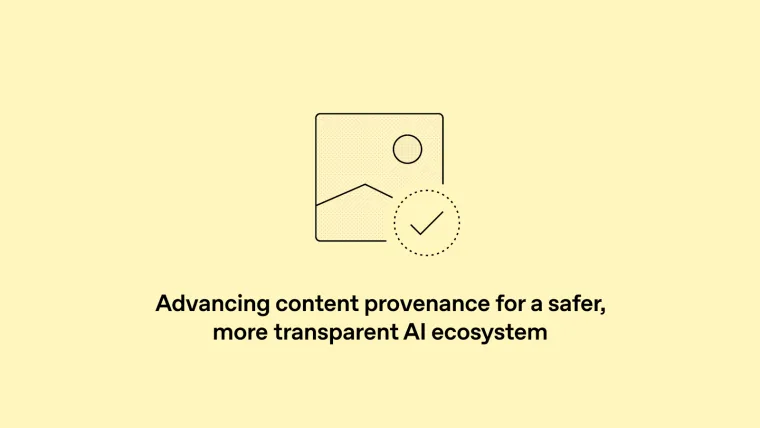
Over on OpenAI News, OpenAI shared a stronger approach to the provenance of AI-generated content, meaning where a piece of media actually came from. Instead of leaning on a single technique, it stacks several layers in a "multi-layered, ecosystem-driven" way. There are three pillars:
- C2PA conformance, so other tools and platforms can read the provenance info
- SynthID, an invisible watermark for images, built together with Google
- A preview of a verification tool that lets you check whether an image came from OpenAI
The goal is to move from "only the creator knows" toward "the people receiving the media can check, too."
The story so far
Since 2024, OpenAI has been adding Content Credentials to images from DALL·E 3, and later to ImageGen and Sora. This rides on C2PA, a cross-industry open standard that uses metadata and cryptographic signatures so information about how a piece of media was made travels with the content itself.
But metadata is not bulletproof. Uploads and downloads, file-format changes, resizing, screenshots, all of these can strip it away or break it. Sometimes that provenance info vanished the moment content left the first platform.
What changes
First, OpenAI itself became a C2PA Conforming Generator Product. By conforming, platforms get a trusted way to read, preserve, and pass along the provenance info OpenAI attaches. Provenance only matters if it survives beyond the first platform, so this is a big deal.
And for the people on the receiving end, the verification tool preview is the headline. Upload an image and it checks for provenance signals, including Content Credentials and SynthID, to tell you whether it was made on ChatGPT, the OpenAI API, or Codex. It is a real step toward letting you answer "Was this generated with AI?" yourself.
Dive Deep
The heart of the multi-layered approach is combining two systems with different strengths:
- C2PA: metadata plus cryptographic signatures carry rich context (where, how, and who signed it). Lots of detail, but easy to strip.
- SynthID (from Google DeepMind): embeds an invisible watermark into the image, starting with images generated through ChatGPT, Codex, or the OpenAI API. It holds up through transformations like screenshots.
The two reinforce each other. When metadata survives, C2PA carries the detail; when metadata is gone, SynthID keeps a signal saying "this came from OpenAI." Together they are far more resilient than either layer alone.
The verification tool builds on lessons from OpenAI's 2024 image detection classifier. It can spot a SynthID watermark that originated from OpenAI and surface C2PA metadata when it is present. The clever part is the caution: if neither metadata nor watermark is found, the tool will not conclude the image was AI-made, because provenance signals can be stripped. No signal does not mean a human made it. I love that honesty.
For now, it only judges content generated by OpenAI. Over the upcoming months, the plan is to extend verification across the industry and support more types of content.
Wrap-up
- OpenAI announced a multi-layered approach to strengthen provenance for AI content (via OpenAI News)
- C2PA conformance helps provenance info survive across platforms
- Google's SynthID adds a hard-to-strip invisible watermark to images
- A public verification tool preview arrived, checking images from ChatGPT, the API, and Codex
- When no signal is found, it deliberately avoids a definitive call
This one lands for creators, journalists, and platform folks who worry about "is this image AI-made?", and for engineers who like standards and provenance plumbing.