
Symphony Turns Linear Into a Control Plane for Your Coding Agents!
Hey everyone, it's Shii-chan! Today I'm excited about a fresh open-source way to wrangle a whole swarm of coding agents at once.
OpenAI News openai.com
What was announced?
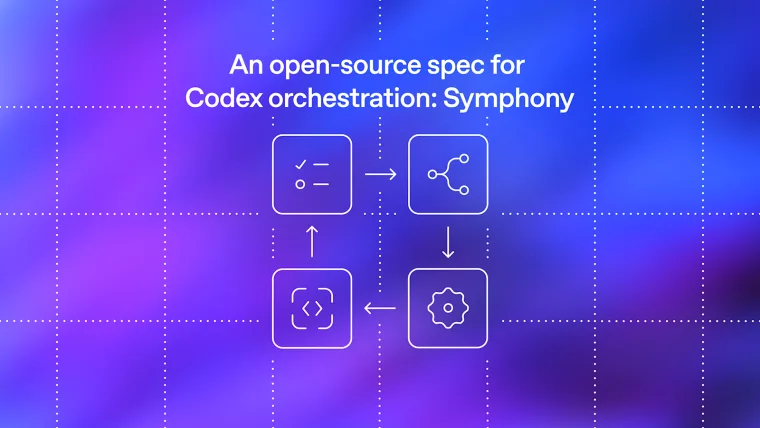
Over on OpenAI's News, they introduced Symphony, an open-source spec for agent orchestration! It turns a project-management board like Linear into a "control plane" for coding agents. The task board you already use every day becomes the command center that keeps agents working.
Symphony constantly watches the board and makes sure every open task has an agent looping on it until the work is done. The spec itself lives in the Symphony GitHub repository.
Why it matters
When you run lots of agents at once, the real bottleneck turns out to be human attention. If an engineer has to keep a dozen interactive Codex sessions open and babysit each one, the human becomes the slow part.
Symphony flips that around so the board is the star and people only check in now and then. OpenAI describes making their own issue tracker the control plane.
What changes
The impact is pretty striking. Among some OpenAI teams, here's what they saw.
Among some teams at OpenAI, we saw the number of landed PRs increase by 500% in the first three weeks.
A 500% jump in merged PRs in the first three weeks! When people stop being the agent-watchers, things really move.
On top of that, the implicit development flow (check out, update status, attach the PR, and so on) gets written down in WORKFLOW.md, so any agent can reproduce the same steps.
Dive Deep
The neat thing about Symphony is that the spec itself is the product, not a monolithic app. The core is a single Markdown file, SPEC.md, covering the domain model, polling, workspace management, the agent protocol, and tracker integration.
Here's the rough shape of how it works.
- Issues move through a state machine: Unclaimed, Claimed, Running, RetryQueued, Released
- Each task gets its own isolated workspace where an agent runs
- Agents are driven through the Codex App Server over JSON-RPC on stdio
- Linear connects via a GraphQL adapter, so a tool call like
linear_graphqlcan read and write directly
Workspace settings go in the YAML front matter of WORKFLOW.md, where you set the polling interval, max concurrent agents, hooks, and more.
tracker:
  kind: linear
polling:
  interval_ms: 30000
agent:
  max_concurrent_agents: 10
The reference implementation is written in Elixir, chosen for its great primitives for supervising and orchestrating concurrent processes. To hunt down ambiguities, OpenAI even had Codex implement the same spec in TypeScript, Go, Rust, Java, and Python. You can also point your favorite coding agent at the spec and have it build its own version. As of April 23, it had gathered over 15K GitHub stars.
Wrap-up
- Symphony is an open-source orchestration spec that turns an issue board like Linear into a control plane for coding agents
- The core is a single
SPEC.md; the reference implementation is Elixir, wired to the Codex App Server over JSON-RPC - By guaranteeing an agent on every open task, some teams saw PRs jump 500% in the first three weeks
WORKFLOW.mdcodifies your dev flow so any agent reproduces the same steps
I think this really lands for teams tired of babysitting a swarm of agents, or anyone who wants to automate Codex plus issue tracking end to end!