
Cloudflare's global network just hit 500 Tbps!
Hey everyone, it's Shii-chan! Today I've got a number so big it makes me giddy just reading about it. It's all about the network that spans the whole world!
Cloudflare Blog blog.cloudflare.com
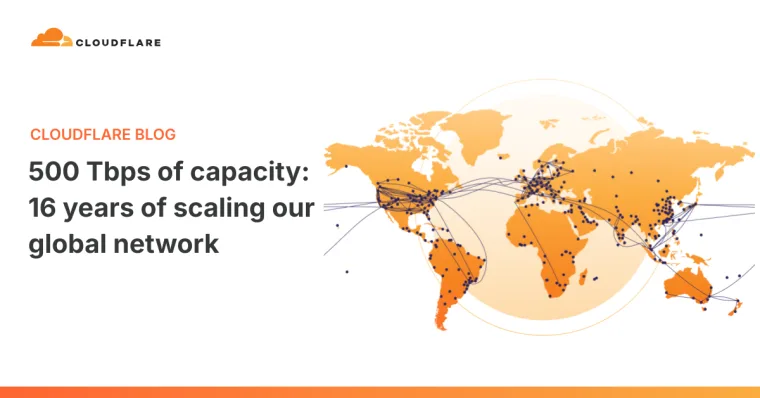
What was announced?
On Cloudflare's Blog, they shared that their global network has reached 500 Tbps of external interconnection capacity, and it's the result of 16 years of steady scaling.
Today Cloudflare runs its network in 330+ cities across 125+ countries, protects more than 20% of the web, and peers with over 13,000 networks and partners. What a scale!
The story so far
Cloudflare started back in 2010 in a tiny office above a nail salon in Palo Alto, with just a single transit provider. A true from-scratch beginning!
From there it kept adding cities, and in 2018 it opened 31 cities in just 24 days, reaching places like Kathmandu, Baghdad, Reykjavik, and Chisinau all around the world.
What changes
500 Tbps is the total external interconnection capacity: the sum of every port facing a transit provider, private peering partner, Internet exchange, or Cloudflare Network Interconnect across all 330+ cities.
Everyday peak usage is only a fraction of that, so there's a huge amount of headroom. And that headroom really shines during attacks. In 2025 they absorbed a 31.4 Tbps DDoS attack in just 35 seconds and blocked over 5,000 attacks that same day. So reassuring!
Dive Deep
The network can defend itself thanks to autonomous edge DDoS protection. Packets flow through an XDP program chain, and an eBPF-based program called l4drop checks them against mitigation rules and drops the bad ones.
A daemon called dosd runs on every server, samples traffic, and builds "heaviest hitter" tables, while Quicksilver, a distributed key-value store, pushes the rules to every data center within seconds. Unimog, a Layer 4 load balancer, spreads the traffic across healthy servers.
Customer code runs on the network too: Workers on every server, KV at the edge, persistent Durable Objects, and Containers, which joined in 2025.
Routing safety matters as well. With RPKI, Cloudflare validates where routes come from and rejects RPKI-invalid ones. Today 867,000 prefixes carry valid RPKI certificates, and they're also working on ASPA, a newer protocol that validates the path itself.
AI crawlers are growing fast too, now making up more than 4% of HTML requests, and "user action" crawling grew 15x in 2025 alone. So with their detection systems you can decide which crawlers to let through.
Wrap-up
- Cloudflare hit 500 Tbps of external interconnection capacity after 16 years
- 330+ cities, 125+ countries, peering with 13,000+ networks
- Everyday usage is just a fraction of capacity, so it absorbs massive DDoS with room to spare
- It defends itself autonomously with homegrown systems like XDP, dosd, Quicksilver, and Unimog
- RPKI and ASPA strengthen routing safety
If you geek out over network scale and the machinery humming behind it, this one's for you!