
Workspace agents land in ChatGPT: build a team agent once, improve it together!
Hey everyone, it's Shii-chan! Today I found a launch that gives teams at work a serious agent upgrade, and I can't wait to walk you through it!
OpenAI News openai.com
What was announced?
From OpenAI's News, workspace agents in ChatGPT are here! These are shared agents a team can create to handle complex tasks and long-running workflows, all within the permissions and controls their organization sets.
They're an evolution of GPTs, and under the hood they're powered by Codex. They can take on the things people already do at work—preparing reports, writing code, replying to messages—and because they run in the cloud, they keep working even when you step away!
Right now they're in research preview for ChatGPT Business, Enterprise, Edu, and Teachers plans.
The story so far
GPTs were already great at making one person faster. But many of the most important workflows in an organization depend on shared context, handoffs, and decisions across teams—and stitching that together used to be manual work.
Workspace agents are built for exactly that. They gather context from the right systems, follow team processes, ask for approval when needed, and keep work moving across tools. OpenAI's own sales team uses one to pull details from call notes and account research, qualify new leads, and draft follow-up emails right in a rep's inbox.
What changes
The best part is 'build it once, and the whole team reuses it.' Open Agents in the ChatGPT sidebar, describe a workflow you do often, and ChatGPT walks you through turning it into an agent.
And it's not just ChatGPT—you can call agents in Slack too, so they show up where work already happens. You can run them on a schedule, or drop them into Slack to pick up requests as they arrive.
To get going fast, there are templates for finance, sales, marketing, and more, each with built-in skills and suggested tools.
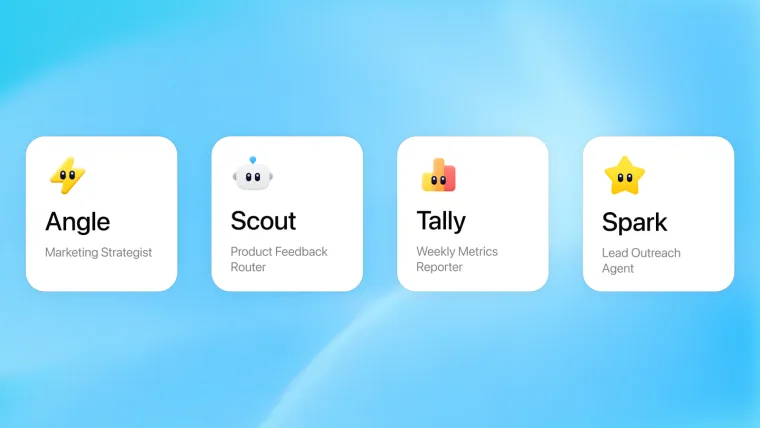
Here are a few agents teams at OpenAI have already built:
- Software Reviewer: checks software requests against approved tools and policies, recommends next steps, and files IT tickets.
- Product Feedback Router: monitors Slack, support channels, and forums, then turns feedback into prioritized tickets and weekly summaries.
- Weekly Metrics Reporter: pulls data every Friday, builds charts, writes the summary, and shares it.
- Lead Outreach Agent: researches inbound leads, scores them, drafts follow-up emails, and updates your CRM.
- Third-Party Risk Manager: researches vendors, assesses signals like sanctions exposure and financial health, and produces a structured report.
Dive Deep
A bit more on how it works. Agents are powered by Codex in the cloud, with a workspace for files, code, tools, and memory. So they do more than answer a prompt: they can write and run code, use connected apps, remember what they learned, and continue across multiple steps.
You stay in control, too. You decide which tools and data an agent can use, what actions it can take, and when it needs approval. Sensitive steps—editing a spreadsheet, sending an email, adding a calendar event—can require permission before the agent proceeds. After you share an agent, analytics show how many runs it has completed and how many people use it.
For enterprises, monitoring and controls are built in: Enterprise and Edu admins can decide which connected tools and actions each user group can access. Safeguards help agents stay on task even against misleading external content, including prompt injection attacks. The Compliance API gives admins visibility into every agent's configuration, updates, and runs.
On pricing, workspace agents are free until May 6, 2026, with credit-based pricing starting that day.
Ankur Bhatt from AI Engineering at Rippling already shared this:
The hard part of building an agent is not the model. It's the integrations, memory, the user experience.
One of their Sales Consultants built a Sales Opportunity agent end to end without an engineering team, and work that used to take reps 5-6 hours a week now runs automatically in the background.
Wrap-up
- Workspace agents land in ChatGPT—an evolution of GPTs, powered by Codex.
- They run in the cloud, work in ChatGPT and Slack, and can run on a schedule.
- You control tools, data, and approvals, and can gate sensitive actions behind permission.
- Enterprise monitoring, a Compliance API, and prompt-injection safeguards are included.
- Research preview for Business, Enterprise, Edu, and Teachers plans, free until May 6, 2026.
If your team repeats the same work again and again, or lives in Slack, this one's for you. 'Build once, improve together' agents—pretty exciting, right?